How a magnet can lift depression
Transcranial magnetic stimulation for depression, in seven steps.
Every step has both. The science view adds the strength of evidence and references.
How it works
Step 1 of 7
Magnetic pulses.
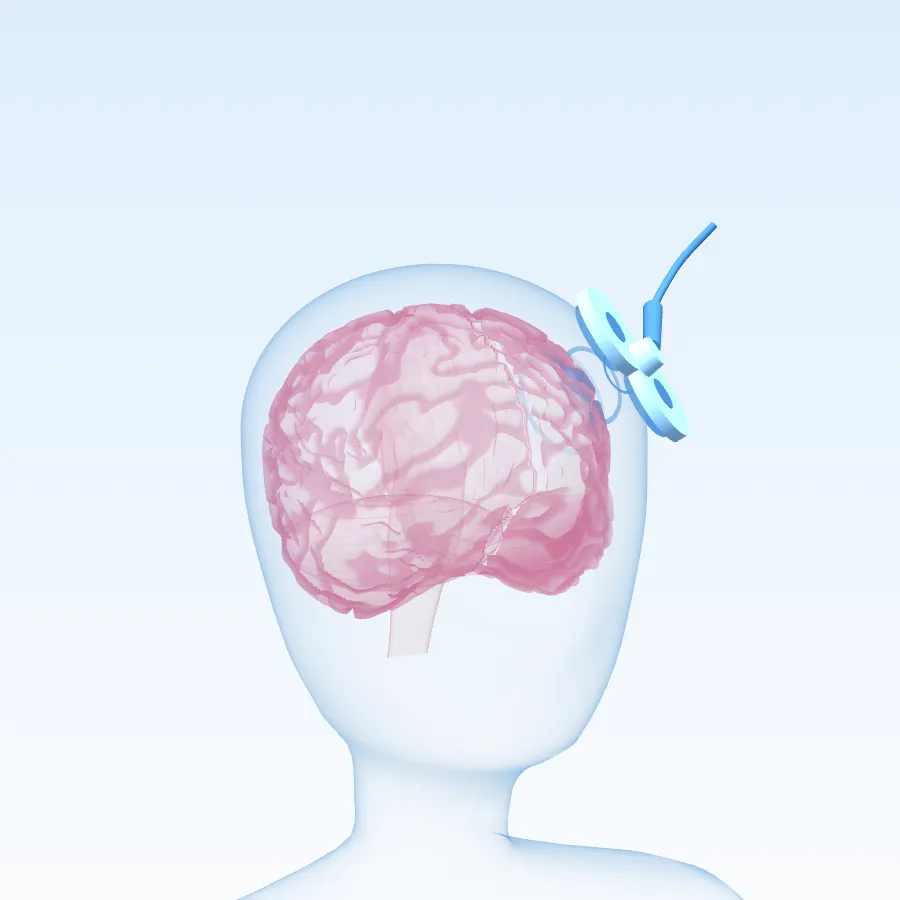
A small magnetic coil rests against the head, over the left front of the brain. It sends quick pulses that pass painlessly through the skull. Most people feel a light tapping.
In the model, each ring leaving the coil is one pulse.
Electromagnetic induction over the left DLPFC
Well establishedA brief, high-current pulse through a figure-8 coil creates a rapidly changing magnetic field that passes through the scalp and skull unimpeded and induces an electric field in the cortex (Faraday induction), focal to a few centimeters of superficial cortex. Standard depression protocols target the left dorsolateral prefrontal cortex with 10 Hz rTMS or intermittent theta burst (iTBS), which was noninferior to 10 Hz in a large randomized trial.
Step 2 of 7
Underactive cells are stimulated.
In depression, this area is often less active. Each pulse creates a tiny electrical current in the nerve cells right under the coil, and they fire.
In the model, the cells nearest the coil light up with each pulse, while cells farther away stay at rest.
Induced currents depolarize cortical neurons
Well establishedEvidence mixedThe induced electric field depolarizes axons of cortical pyramidal neurons and interneurons within the field, generating action potentials. Field strength falls off rapidly with depth and distance from the coil, so effects are focal. Reduced left prefrontal activity has been reported in depression, although imaging findings vary across studies.
Step 3 of 7
Repetition strengthens connections.
Sessions are repeated, usually daily over several weeks. Some schedules fit sessions into fewer days. Repeated stimulation can strengthen connections between nerve cells, much as practice strengthens a skill.
In the model, the counter runs through a course of sessions, and lines form between the cells as their connections strengthen.
Repetition drives LTP-like plasticity
Human evidenceLeading modelHigh-frequency rTMS and iTBS produce lasting increases in cortical excitability that resemble long-term potentiation (LTP) and depend on NMDA receptors. Cumulative sessions are thought to consolidate these changes. FDA-cleared courses run about 6 weeks; accelerated schedules deliver multiple sessions per day.
Step 4 of 7
The mood network rebalances.
The front area is wired to a deeper mood area that is often overactive in depression. Strengthening the front area may help reduce that deeper area’s overactivity.
In the model, a pathway links the two areas, and the deeper area turns from orange to green as it settles.
Network effects: DLPFC and subgenual cingulate
Human evidenceLeading modelThe subgenual anterior cingulate cortex (sgACC) is hyperactive in depression. Clinical efficacy of DLPFC stimulation tracks how strongly the stimulated site is anticorrelated with the sgACC in resting-state connectivity, which supports the idea that TMS acts on mood networks through this connection.
Your visit
Step 5 of 7
What a session feels like.
You sit awake in a treatment chair, wearing earplugs, while the coil delivers pulses. Afterward, you can drive yourself home and go about your day.
The model shows the coil in position for a session, which lasts about 3 to 20 minutes.
Session procedure and safety
FDA labeling / guidelinesTreatment intensity is set relative to each patient’s resting motor threshold. No anesthesia or sedation is used, and hearing protection is required because of the coil’s click. The most common adverse effects are scalp discomfort and headache. Seizure is rare. Cognitive adverse effects were not observed in pivotal trials.
Results
Step 6 of 7
Most people improve.
In everyday clinics, about 6 in 10 people respond to a course of TMS, and nearly 4 in 10 become free of depression. These are people whose depression had not improved enough with medicine.
The change is usually gradual. Sleep, energy and interest often come back before mood does, and family may notice before you do.
In the model, the deeper mood area has turned green, the color of a settled circuit.
Outcomes in clinical practice
Human evidenceIn a naturalistic study of 307 patients treated with TMS in clinical practice, 58% responded and 37% reached remission on clinician rating. Among people who respond, about half still hold that response a year later, and maintenance sessions may improve durability.
The order in which symptoms improve is a clinical observation and varies from person to person.
Step 7 of 7
What getting better looks like.
A magnet tapping on the head can seem a strange way to treat depression. What it does is help a mood circuit work the way it should.
People describe getting out of bed more easily, enjoying a meal, picking up the phone, and making plans again. Life gets bigger.
The goal is to get you back to yourself.
The model shows the mood network in balance, with the coil put away.
Functional recovery
Well establishedRecovery of functioning, in work, relationships and daily life, is a central goal of depression treatment alongside relief of symptoms, and it is tracked through treatment with rating scales and clinical review.
What a session is like
- You’re awake, seated in a comfortable chair. No anesthesia or sedation.
- You’ll hear clicking and feel tapping on your scalp.
- Sessions last about 3 to 20 minutes, depending on the treatment plan (longer on accelerated schedules).
- Afterward, you can drive and go about your day.
Good to know
- FDA-cleared for depression since 2008. TMS for OCD uses a different target and has its own guide.
- The most common side effects are scalp discomfort and headache, which usually ease after the first few sessions. Seizures are rare.
- TMS is not ECT: no anesthesia, and it has not been shown to affect memory.
Clinical status
- Depression: FDA-cleared since 2008 for adults with major depressive disorder who did not benefit from antidepressant medication; anxious depression added to MagVenture’s clearance in 2025.
- Accelerated protocols: multiple sessions per day; evidence is growing, and not every schedule is FDA-cleared.
These pictures simplify how TMS is thought to work. Results vary from person to person. For education only; this is not medical advice. Ask your care team whether TMS is right for you.
The science view summarizes mechanisms and the strength of evidence for each step. Individual results vary. For education only; this is not medical advice.
The takeaway
- TMS uses magnetic pulses on the outside of the head. There is no anesthesia and no medicine.
- Repeated sessions strengthen an underactive mood area and help the mood network rebalance.
- A course is usually daily sessions over several weeks, and you can drive home after each one.
What you can do next
- Read “Is TMS safe?” for side effects and risks.
- Write down the antidepressants you have tried. Insurance often asks.
- Request a consultation to ask what fits you.
Ready to take the next step?
Your first consultation is an evaluation, not a commitment to any treatment. Our patient advocate calls you back within one business day.