VNS: a small implant for long-lasting depression
Vagus nerve stimulation for long-lasting depression, in six steps.
Every step has both. The science view adds the strength of evidence and references.

Step 1 of 6
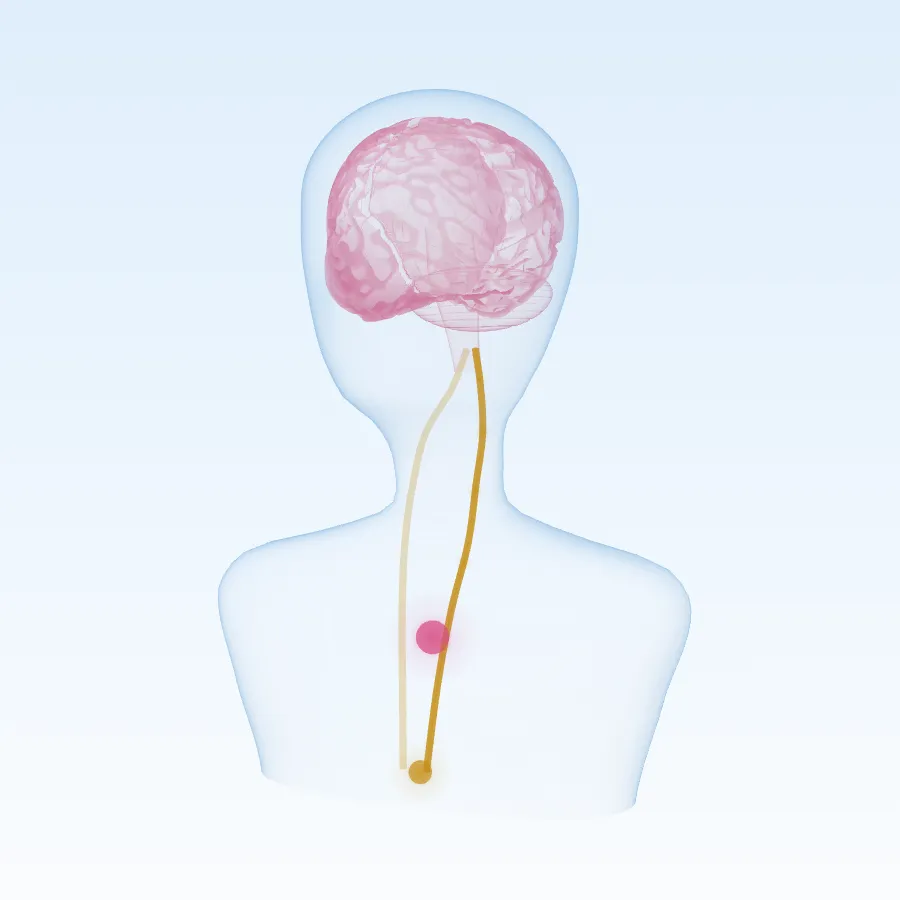
The vagus nerve.
The vagus nerve runs from the brain down the neck to the heart and belly. Most of its signals travel up to the brain, which gives it a direct route to brain areas that regulate mood.
In the model, the nerve is the gold line running from the base of the brain down through the neck and chest.
A largely afferent pathway into the brainstem
Well establishedThe vagus nerve (cranial nerve X) carries parasympathetic output to the viscera, but roughly 80% of its fibers are afferent, conveying visceral information to the brainstem, chiefly the nucleus tractus solitarius (NTS). That ascending route is what VNS uses to reach the brain.
Step 2 of 6
A small device, placed once.
A pacemaker-like device goes under the skin of the left chest, with a thin wire to the vagus nerve in the neck. It’s placed during a short outpatient surgery.
The model shows the device in the upper chest and the wire running up to the nerve.
Implanted pulse generator and cervical lead
FDA labeling / guidelinesA pulse generator is implanted subcutaneously in the left chest and tunneled to helical electrodes on the left cervical vagus. The left side is used to limit cardiac effects. FDA-approved in 2005 as adjunctive long-term treatment for chronic or recurrent depression in adults whose episode has not responded adequately to four or more adequate antidepressant treatments.
- FDA PMA approval, July 2005 (VNS Therapy System, depression indication)
Step 3 of 6
Pulses on a set schedule.
The device sends gentle pulses up the nerve automatically, on and off throughout the day. You don’t have to do anything.
In the model, pulses travel up the nerve while the device is stimulating, then pause while it rests.
Intermittent stimulation, titrated over weeks
FDA labeling / guidelinesHuman evidenceStimulation is delivered in duty cycles, commonly about 30 seconds on and 5 minutes off at 20–30 Hz. Output current starts low and is titrated over several weeks at office visits to balance benefit against side effects such as voice change.
Step 4 of 6
Signals reach mood circuits.
The signals reach a relay station in the brainstem, which passes them to areas that make norepinephrine and serotonin, and on to mood circuits.
In the model, the relay station is gold, the norepinephrine pathway is blue, and the serotonin pathway is pink.
Brainstem relays to limbic and prefrontal networks
Mostly animal evidenceHuman evidenceThe NTS projects to the locus coeruleus (norepinephrine) and dorsal raphe (serotonin). In rats, sustained VNS increases firing in both nuclei over weeks. Human imaging studies report VNS-related changes in limbic and prefrontal activity, though findings vary.
Step 5 of 6
Gradual benefit.
VNS works gradually. Benefits often build over months and can keep growing over years. It’s a long-term treatment for long-lasting depression.
In the model, the timeline runs from three months to five years, and the highlight over the mood circuits grows stronger.
Gradual, cumulative benefit
Human evidenceEvidence mixedThe 10-week sham-controlled pivotal trial did not separate from sham on its primary outcome. Longer-term data are more favorable: VNS plus usual care outperformed usual care alone at 12 months, and in a 5-year registry it showed higher cumulative response and remission than treatment as usual. These are nonrandomized comparisons, so the evidence is weaker than for TMS or esketamine.
Step 6 of 6
What to expect.
Your voice may sound hoarse while the device is pulsing. A clinician adjusts settings with a wand at checkups, and a magnet can pause it if needed.
The model shows ripples at the throat while the device pulses, and the wand held over the device.
Side effects, programming and follow-up
FDA labeling / guidelinesThe most common stimulation-related effects are voice alteration, cough, shortness of breath and neck discomfort, mainly during on-time and often lessening over time. Surgical risks include infection and vocal cord problems. Settings are adjusted noninvasively with a programming wand, and a magnet temporarily stops stimulation. MRI is allowed only under specific conditions.
Good to know
- VNS is FDA-approved for long-lasting depression that hasn’t improved after four or more treatments.
- It works alongside your other treatments, not instead of them.
- Benefits build slowly, so it’s a long-term plan.
Ask your care team
- Am I a candidate for VNS?
- What does the surgery and recovery involve?
- Will my insurance cover it?
Clinical status
- FDA: approved July 2005 as adjunctive therapy for chronic or recurrent treatment-resistant depression (≥4 failed adequate treatments), adults 18 and older.
- Evidence base: negative acute sham-controlled trial; favorable long-term naturalistic data; ongoing registry studies.
- Coverage: varies by payer; Medicare coverage is tied to participation in an approved study.
These pictures simplify how VNS is thought to work. Individual results vary. For education only; this is not medical advice. Ask your care team whether VNS is right for you.
The science view summarizes mechanisms and evidence for each step. Individual results vary. For education only; this is not medical advice.
The takeaway
- VNS uses a small device, placed once, that sends pulses to the vagus nerve in the neck.
- The signals travel on to mood circuits in the brain.
- Benefit builds gradually. VNS is for depression that has lasted a long time.
What you can do next
- List the treatments you have already tried.
- Ask us whether VNS could be an option for you.
- Request a consultation to ask what fits you.
Ready to take the next step?
Your first consultation is an evaluation, not a commitment to any treatment. Our patient advocate calls you back within one business day.