Why ketamine and Spravato can work in days
One leading explanation, in six steps, from a single receptor to the mood circuits it reconnects.
Every step has both. The science view adds the strength of evidence and references.

Step 1 of 7
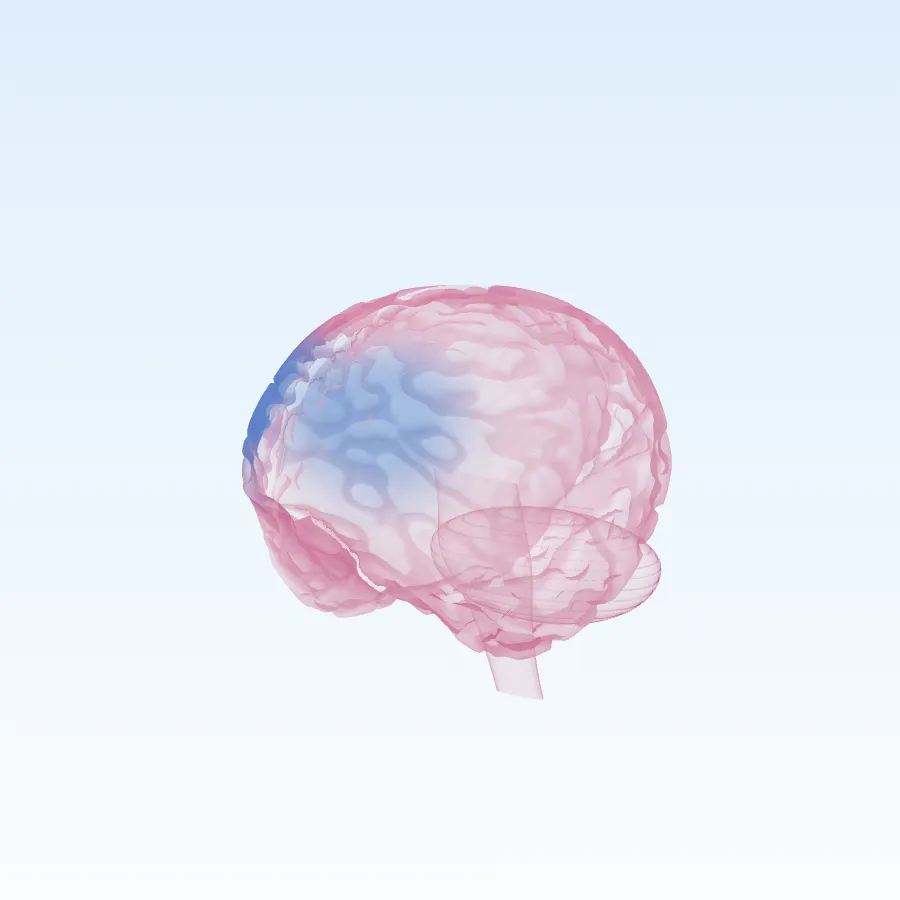
The prefrontal cortex.
The prefrontal cortex, at the front of the brain, helps regulate mood and decision-making. In depression, connections between nerve cells here are often weakened. Ketamine acts in this area and others.
In the model, the highlighted region at the front of the brain is the prefrontal cortex.
Target region: the prefrontal cortex
Well establishedMostly animal evidenceChronic stress and major depression are associated with loss of synapses and dendritic spines in the prefrontal cortex (PFC) and hippocampus in animal models, with convergent human imaging and postmortem findings. Most mechanistic work on ketamine’s rapid action centers on PFC microcircuits, though it also acts elsewhere, including the lateral habenula, where it blocks NMDA-dependent burst firing.
Step 2 of 7
Inhibition holds signaling back.
Inhibitory nerve cells normally restrain nearby signaling cells, limiting how much glutamate, the brain’s main excitatory messenger, they release.
The model now shows three nerve cells up close: an inhibitory cell on the left, a signaling cell in the middle, and a receiving cell along the bottom. Glutamate is shown as orange dots, and here only a few reach the receiving cell.
Tonic GABAergic inhibition of pyramidal neurons
Well establishedFast-spiking GABAergic interneurons provide tonic inhibition onto cortical pyramidal neurons. These interneurons are tonically active and partly driven through NMDA receptors, which makes them especially sensitive to NMDA blockade at subanesthetic concentrations.
Step 3 of 7
Two mirror-image molecules.
Ketamine is an equal mix of two molecules that are mirror images of each other, like a left and a right hand. One is esketamine, which binds the NMDA receptor more tightly. Spravato contains only esketamine.
In the model, the two molecules turn as mirror images of each other. Esketamine is on the right.
Enantiomers of ketamine
Well establishedRacemic ketamine contains equal parts (S)-ketamine (esketamine) and (R)-ketamine (arketamine). Esketamine has about a three- to fourfold higher affinity for the NMDA receptor (Ki about 0.30 μM versus 1.4 μM). Higher receptor affinity does not by itself establish greater antidepressant benefit.
Step 4 of 7
The medicine blocks a receptor.
Ketamine and esketamine block the NMDA receptor on inhibitory cells, which reduces their restraining effect.
In the model, the medicine is shown in pink. One particle moves into the receptor on the inhibitory cell and blocks it.
Use-dependent NMDA receptor channel block
Well establishedKetamine is a noncompetitive, open-channel (trapping) blocker: it enters the NMDA receptor pore when the channel opens and binds the PCP site within it. The S-enantiomer, esketamine, has higher NMDA receptor affinity than R-ketamine. Racemic ketamine is a 1:1 mix of both.
Step 5 of 7
Glutamate signaling increases.
With less inhibition, signaling cells release a burst of glutamate.
In the model, many more orange dots now stream from the signaling cell to the receiving cell.
Disinhibition and a prefrontal glutamate surge
Leading modelMostly animal evidenceReduced interneuron firing disinhibits pyramidal neurons, producing a transient rise in extracellular glutamate in the PFC at subanesthetic doses. Postsynaptic AMPA receptor activation is required: AMPA antagonists block ketamine’s antidepressant-like effects in rodents.
Step 6 of 7
New connections grow.
The burst releases a growth signal (BDNF). Over hours to days, nerve cells grow new connections, which may help mood improve.
In the model, the growth signal is shown in green, and new connection points appear along the receiving cell.
BDNF–TrkB–mTORC1 signaling and synaptogenesis
Mostly animal evidenceAMPA-driven depolarization triggers activity-dependent BDNF release, TrkB activation and mTORC1 signaling, increasing synaptic protein synthesis and dendritic spine density in PFC within about 24 hours in rodents. A complementary pathway runs through eEF2 kinase and rapid BDNF translation. New spine formation is needed to sustain the behavioral effect.
Step 7 of 7
Mood circuits reconnect.
The new connections may help mood-regulating brain areas communicate more effectively. This may help explain why these medicines can work faster than standard antidepressants for some people.
The model returns to the whole brain, with pathways linking the prefrontal cortex to other mood areas.
Network level: prefrontal connectivity and rapid onset
Human evidenceEvidence mixedIn patients with major depression, ketamine has been associated with increased prefrontal global brain connectivity, though human connectivity findings vary across studies. IV ketamine produced antidepressant effects within 24 hours in randomized trials. Esketamine’s pivotal trials used a 28-day primary endpoint.
Esketamine (Spravato)
One mirror-image form of the ketamine molecule. A nasal spray given in a certified clinic, with monitoring afterward. FDA-approved for treatment-resistant depression.
Ketamine
A 50:50 mix of two mirror-image forms. Usually given by IV infusion. Its use for depression is off-label, supported by clinical trials.
Other mechanisms under study
- NMDA blockade at rest: blocking spontaneous NMDA activity relieves eEF2 kinase suppression of BDNF translation (Autry et al. 2011).
- Metabolites: (2R,6R)-hydroxynorketamine produced antidepressant-like effects in mice independent of NMDA blockade (Zanos et al. 2016, Nature); its relevance in humans is unresolved.
- Opioid system: naltrexone attenuated ketamine’s effect in one small trial (Williams et al. 2018, Am J Psychiatry) but not in another (Yoon et al. 2019, JAMA Psychiatry).
- Lateral habenula: ketamine blocks NMDA-dependent burst firing (Yang et al. 2018, Nature).
- Esketamine (Spravato): FDA-approved for treatment-resistant depression (2019), for depressive symptoms in MDD with acute suicidal ideation or behavior (2020), and as monotherapy for TRD (2025). Administered under a REMS with post-dose monitoring.
- Racemic ketamine: FDA-approved as an anesthetic; IV use for depression is off-label, supported by randomized trials.
This is one leading explanation, based mostly on animal research. Scientists are still learning exactly how these medicines work. For education only; this is not medical advice. Ask your care team whether a treatment is right for you.
The science view summarizes the leading mechanistic model and the strength of evidence for each step. Much of the cellular evidence comes from rodent studies. Individual results vary. For education only; this is not medical advice.
The takeaway
- Ketamine and esketamine block a receptor on nerve cells in the front of the brain.
- That sets off a burst of signaling, and new connections grow between cells.
- This is the leading explanation for why these medicines can work within days.
What you can do next
- Read “Are Spravato and ketamine safe?” for what to expect.
- See “Your Spravato visit” for a treatment day, step by step.
- Request a consultation to ask what fits you.
Ready to take the next step?
Your first consultation is an evaluation, not a commitment to any treatment. Our patient advocate calls you back within one business day.